Tooling Around the Matheson History Museum
  • Blog
  • About
  • Contact
  • New Page

Zig-Zag and Slide Rules

12/7/2015

0 Comments

 
In this post I will look at a type of folding ruler commonly known as zig-zag rulers, and an interlocking or slide ruler. Zig-zag rulers are folding rulers made up of a number of short pieces with locking hinges connecting the pieces. When fully opened, a zig-zag ruler is often six or eight feet long, and is stiff enough to be held in one hand while being used to measure. These are the tools that I have always thought of as "carpenter's folding rules." I bought one when I started my (one and only) summer construction job in 1962, and I have one in my garage today.
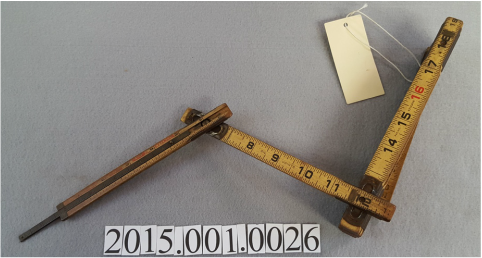
The first zig-zag folding ruler from the Tison Tool Barn collection is this Lufkin Red End rule with a slide extension. The rule is 96 inches long when fully extended. The model number on this tool is badly smeared and unreadable, but a Lufkin Wood Rule Red End with Slide Rule Extension, Model No. X48, is still on the market.

Picture
Lufkin Red End ruler with slide extension. Photo by Donald Albury.
Picture
Lufkin Red End folding ruler, partially unfolded, with slide partially extended. Photo by Donald Albury.
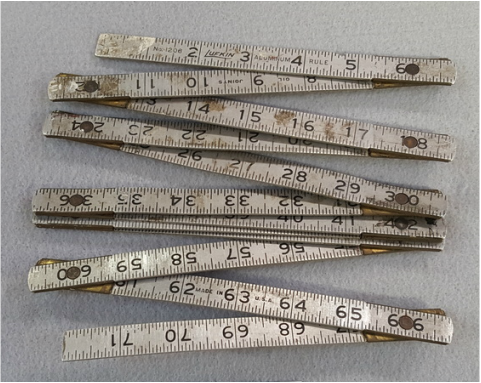
The next folding rule is this Lufkin Model 1206 aluminum rule with brass hinges. Offerings for sale of examples of this rule on the Internet attribute it to the period from the 1920s through the 1950s. This ruler is 7 inches long folded, and 72 inches long fully extended. 

Picture
Lufkin Model No. 1206 aluminum zig-zag rule. Photo by Donald Albury.
Picture
Lufkin Model No. 1206 ruler partially unfolded. Photo by Donald Albury.
Picture
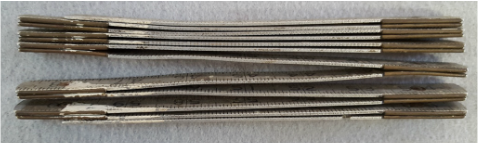
Side view of Lufkin Model No. 1206 showing accumulation of bends in the aluminum sections. Photo by Donald Albury.
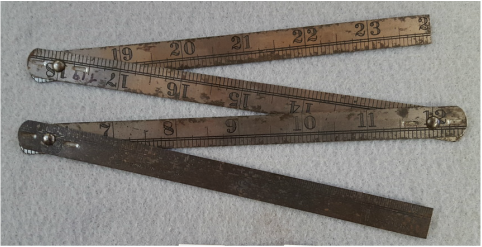
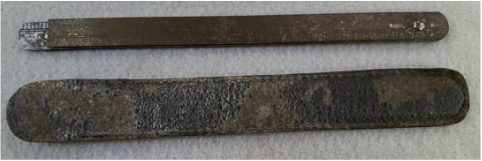
The third zig-zag ruler in the Tison Tool Barn is this 24-inch long steel ruler. The only marking on it is the legend "MADE IN GERMANY." It has a leatherette case.
Picture
Partially unfolded teel zig-zag ruler. Photo by Donald Albury.
Picture
Folded steel zig-zag ruler with case. Photo by Donald Albury.
The final ruler from the Tison Tool Barn covered in this post is not really a folding ruler, but it is closely related, and is used like a zig-zag ruler. It is an Interlox Master Slide Rule, Model No. 106. Instead of legs swinging on hinges, each segment slides over the next segment, with clips on the edges keeping the segments rigidly in line. (The hinges on zig-zag rulers may loosen with use, allowing unwanted bends in an extended ruler.) It was advertised as ideal for measuring inside dimensions. This example of the Interlox ruler is 72 inches long fully extended. Rulers could be ordered from the manufacturer in one-foot increments of length. This ruler was advertised in a 1915 edition of Popular Mechanics magazine, and remained in production at least until World War II.

Picture
Interlox Master Slide Rule, exterior measurement side. Photo by Donald Albury.

Picture
Interlox Master Slide Rule, exterior measurement side. Photo by Donald Albury.

Picture
Partially extended slide rule, side view. Photo by Donald Albury.

Picture
Partially extended slide rule, top view. Photo by Donald Albury.
There are a number of plain old rulers and yardsticks in the Tison Tool Barn, but I'll get around to them some other time.
Sources:
  • Lufkin Red End folding ruler Model No. X46
  • Unusual Tools: Interlox Master Slide Rule
  • Popular Mechanics, April, 1915, page 167
0 Comments

More Folding Rulers

11/30/2015

0 Comments

 
The Tison Tool Barn houses several two-foot long (and one three-foot long) folding rulers. All of those rulers are four-fold. Unlike the one-foot folding rulers described in the previous post, none of the two-foot folding rulers have calipers. Some of the rulers described in this post do have other tools combined with them.
Six of the two-foot folding rulers in the Tison Tool Barn were made by the Stanley Rule and Level Company. The collection includes two examples of the Stanley Model No. 62 folding ruler. This model is distinguished by brass banding that covers the narrow sides of the legs of the ruler, and the large brass caps flanking the center hinge.
Picture
One of the Stanley Model No. 62 folding rulers in the Tison Tool Barn. Photo by Donald Albury.
Picture
A Stanley Model No. 62 folding ruler, fully extended. Photo by Donald Albury.
The Tison Tool Barn holds three examples of the Stanley Model No. 68 folding ruler. This model has brass hinges and end caps, but does not have brass edging or any brass flanking the central hinge.
Picture
Stanley Model No. 68 folding ruler. Photo by Donald Albury.
Picture
A Stanley Model No. 68 folding ruler, fully extended. Photo by Donald Albury.
The Tison Tool Barn also holds a Stanley Model No. 84 folding ruler. The Model No. 84 has brass banding flanking the center hinge, similar to the Model No. 62 shown above, but does not have brass edging on the narrow sides of the legs.
Picture
Stanley Model No. 84 folding ruler. Photo by Donald Albury.
Picture
Stanley Model No. 84 folding ruler, half-open. Photo by Donald Albury.
Picture
Stanley Model No. 84, fully extended. Photo by Donald Albury.
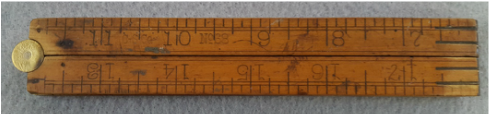
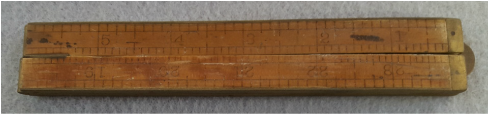
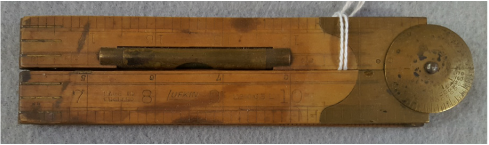
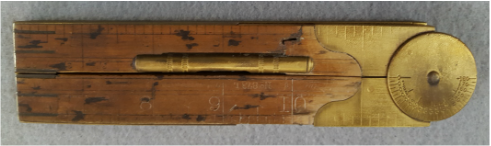
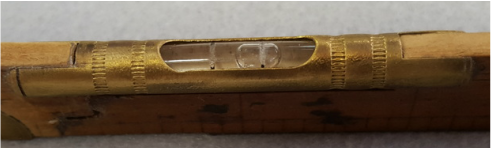
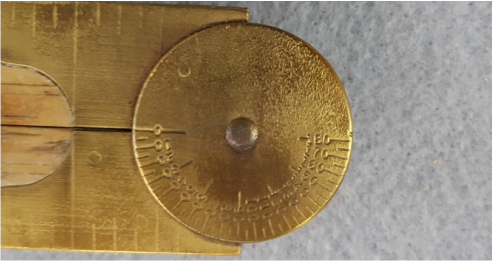
The Tison Tool Barn has a few folding rulers made by the Lufkin Rule Co. Two of them are combination tools, and include a spirit-bubble level and a bevel, or angle-gauge (a protractor). The latter allows a worker to measure and transfer angles. First is this Model No. 863 L.
Picture
Lufkin Model No. 863 L folding ruler. Photo by Donald Albury.
Picture
Lufkin Model No. 863 L, fully extended. Photo by Donald Albury.
Next is the Model No. 873 L. The spirit-bubble on the Model No. 873 L is slightly shorter, and positioned a little closer to the central hinge, than that on the Model No. 863 L. There is also a difference in the profile of the brass banding next to the center hinge.
Picture
Lufkin Model No. 873 L folding ruler. Photo by Donald Albury.
Picture
Detail of the spirit-bubble on the Lufkin Model No. 873 L. Photo by Donald Albury.
Picture
Detail of the angle-gauge on the Lufkin Model No. 873 L folding ruler. Photo by Donald Albury.
Another Lufkin folding ruler in the Tison Tool Barn is the Model No. 3851. Unlike the other rulers covered in this post, the Model No. 3851 is three feet long when fully opened. It is a four-fold ruler, so each segment is nine inches long,
Picture
Lufkin Model No. 3852 folding ruler. Photo by Donald Albury.
Picture
Lufkin Model No. 3852 folding ruler, fully extended. Photo by Donald Albury.
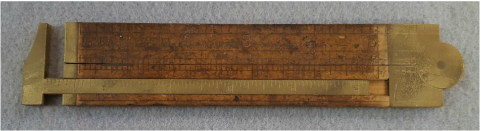
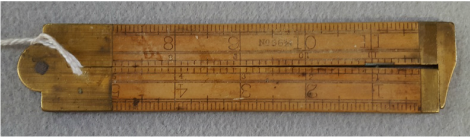
The last item in this post, from the first half of the 19th century, is older than the others covered here. The ruler is marked "J. WATTS  BOSTON." Joseph Watts is known to have produced tools in Charleston, Mass. from 1834 until 1849. This ruler is two feet long, and four-fold. One end segment has an extension bar, which may be slid out almost six inches. This feature makes it easy to measure inside an opening of up to almost 2-1/2 feet across, using only one hand to hold the ruler. (Various foldings of the ruler give a base measurement of 6, 12, 18 or 24 inches.)  One of the uses for this tool in the 19th century would have been finding the inside diameter of a cask, needed to calculate the capacity of the cask.
Picture
Folding Ruler made by Joseph Watts. Photo by Donald Albury.
Picture
Detail of marking, " J. WATTS BOSTON". Photo by Donald Albury.
In my next post I will look at a few zig-zag rulers, and one interlocking or slide ruler, that are in the Tison Tool Barn.
Sources:
  • ​Antique Rules and Rulers
  • Stanley
  • Lufkin
  • J. Watts
0 Comments

Folding Rulers: Part I

11/23/2015

 
A folding ruler, also known as a carpenter's ruler or mason's ruler, folds or otherwise collapses, so that it is generally between six and eight inches long when folded, and can be kept in a pocket. Carpenter's overalls typically have a special pocket on the side of a leg to hold one of these rulers. (Carpenter's overalls sold today may advertise this pocket as also suitable for holding a cell phone.) Folding rulers have been largely replaced by tape measures, but 'zig-zag' rulers are still being manufactured. 
Folding rulers have a long history. A (Roman) foot-long folding ruler made of brass was found in the ruins of Pompeii. Folding rulers are known from Italy by the end of the 16th century. Most folding rulers were made from wood, particularly boxwood. Some were made of ivory or bone, while many are now made of metal or man-made materials. Hinges, swivel joints, and bandings were usually made of brass or 'German silver' (a copper and nickle alloy). 
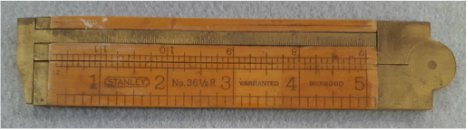
The Tison Tool Tool barn collection includes about 20 folding rulers. The five rulers covered in this post are all made of boxwood and brass, and all include a caliper for measuring the outside diameter or width on an object. The first three are two-fold, and are one foot long when opened.  The caliper on these three rulers each have a bar just over five inches long, which would allow measurement of objects up to about four inches in diameter.
First is this folding ruler, a model No. 36-1/2 made by the Stanley Tool and Level Company.
Picture
Stanley model No. 36-1/2 folding ruler. Photo by Donald Albury.
Picture
Stanley model No. 36-1/2 ruler unfolded for use. Photo by Donald Albury.
This next folding ruler doe not have a manufacturer's mark on it, but it is labeled as a model No. 36-1/2, and was probably made by Stanley.
Picture
Probable Stanley model No. 36-1/2 folding ruler. Photo by Donald Albury.
This next folding ruler is also a one-foot two-fold ruler, a Stanley model 36-1/2 R. (Stanley also made a model 36-1/2 L folding ruler, but the Tison Tool Barn does not have an example of that model.) I am not aware of how this ruler (model 36-1/2 R) differs from the plain model 36-1/2.
Picture
Stanley model No. 36-1/2 R folding ruler. Photo by Donald Albury.
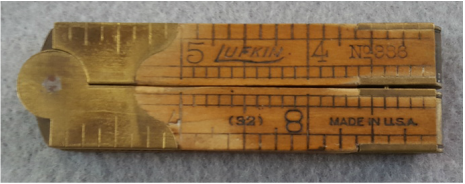
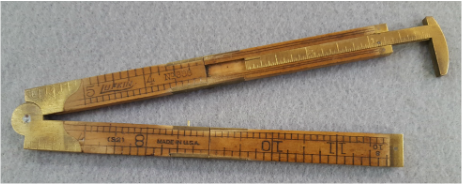
The next folding ruler in the Tison Tool Barn is a Lufkin model No. 386, made of boxwood and brass. It is also one foot long when opened, but is four-fold, meaning that is is only about 3-1/4 inches long when folded. This ruler also has a caliper, but the bar is only three inches long.
Picture
Lufkin model No. 386, folded. Photo by Donald Albury.
Picture
Lufkin model No. 386 partially unfolded. Photo by Donald Albury.
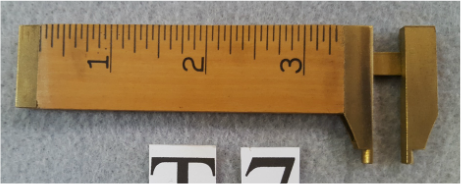
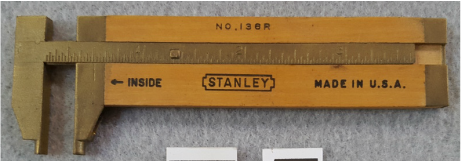
The last item in this post is not a folding ruler, but at just four inches long, does count as a pocket ruler. It is a Stanley model No. 136 R, and includes a caliper.
Picture
Stanley model No.136 R caliper ruler, front side. Photo by Donald Albury.
Picture
Stanley model No. 136 R, back side. Photo by Donald Albury.
In my next post I will look at some two-foot long folding rulers from the Tison Tool Barn collection.
Sources:
  • Antique Rules and Rulers
  • Tape Measure Versus Folding Rule
  • Boxwood Rulers
  • Striped Carpenter Overall
  • Barlow, Ronald S. 1999. The Antique Tool Collector's Guide to Value.​ Page 168.
  • Stanley
  • Lufkin

    Author

    I have been a volunteer at the Matheson History Museum. Feeling an affinity with old hand tools (some of which I remember from my youth), I have tried to learn more about the history of the tools in the Tison Tool Barn, and how they were used.

    I am not an expert on tools. I have used some of the tools represented in the Tison Tool Barn, though perhaps not very well. I do enjoy digging around to find out more about the tools, and hope that some of you share my interest in the old tools collected in the Tison Tool Barn.

    This is my personal blog. Any claims, suppositions or opinions offered here are mine, and do not necessarily represent those of the Matheson History Museum, its staff or its Board of Directors.

    All text and photographs by Donald Albury in this blog are licensed under a Creative Commons Attribution-ShareAlike 4.0 International License. All illustrations taken from Wikimedia Commons are either in the public domain, or have been released under a Creative Commons license.

    Archives

    December 2015
    November 2015
    October 2015
    September 2015
    August 2015
    July 2015
    June 2015

    RSS Feed

    Categories

    All
    Acme-wrench
    Auger
    Auger Bits
    Barnes Tool Company
    Bemis & Call
    Bicycle Wrench
    Bit Gauge
    Brace
    Center Bit
    Chuck
    Coes Wrench Co.
    Combination Wrench
    Cooper Tools
    Countersink Bit
    Crescent Wrench
    Drawknife
    Factory
    Folding Ruler
    Gimlet
    Hammer Wrench
    H. D. Smith
    Hollow Auger
    Inshave
    Lucas Girder Wrench
    Marking Gauge
    Matheson History Museum
    Miehle
    Monkey Wrench
    Peck
    Perfect Handle
    Pipe Wrench
    Reamer Bits
    Ripley's Patent Wrench
    Sheffield
    Skid Shoe
    Slide Ruler
    Spofford
    Spoke Pointer
    Stillson
    Stow
    Tison Tool Barn
    Wagon Jack
    Washer Cutter
    & Wilcox
    Zig-zag Ruler

    Interesting Sites about Old Tools

    • Collectors Weekly: Tools and Hardware
    • A Woodworker's Musings
    • Walsh, Peter C., Woodworking Tools 1600-1900, Smithsonian Institution. The e-book version is downloadable for free from Project Gutenberg.
    • Directory of American Tool and Machinery Patents
    • Alloy Artifacts - 20th century hand tools
    • Wheels that Won the West - About wagons, which are a type of tool
Powered by Create your own unique website with customizable templates.
  • Blog
  • About
  • Contact
  • New Page